A dining table is never just furniture. It’s where a household slows down, where guests are welcomed, and where the small rituals of a day — breakfast before school, a glass of wine after work, a Sunday lunch that runs long — actually happen. In feng shui, this makes the dining space one of the most consequential rooms in the home: it governs nourishment, abundance, and connection, and how the table sits within the room shapes whether that energy flows freely or gets stuck.
We put together this guide after a recent feng shui breakdown we shared with our community, and wanted to expand on it properly here — with more context on why each principle matters, and how to apply it even when your dining room isn’t a perfect square. If you’re working through the rest of your home too, our broader feng shui interior design guide covers room-by-room energy flow, and our dining room design guide goes deeper on layout and styling beyond feng shui alone.
1. Place the Table in the Command Position

The “command position” is a feng shui fundamental that applies to any room built around a single anchor piece — a bed, a desk, or in this case, a dining table. The idea is simple: your table should be visible from the entrance to the room, but not sitting in a direct line with the door. When you can see the table as you walk in, without feeling like the doorway is aiming straight at your seat, the space reads as secure rather than exposed. That sense of security is what allows people to actually relax at the table, rather than sitting with their back unconsciously braced toward the entrance.
In practice, this often means angling the table slightly off the door’s sightline, or using the natural offset of an entryway, hallway, or kitchen pass-through to break the direct line. If your dining area opens straight off a front door or a busy hallway, even a low console table, a room divider, or a change in flooring can soften that direct energetic path.
2. Keep Pathways Clear

Circulation matters as much as placement. Leave enough space around the table for people to pull out chairs, walk past comfortably, and move between the table and the rest of the room without squeezing past furniture. In feng shui terms, clear pathways let energy — and conversation — move freely through the space. A dining area that’s been overcrowded with an oversized table or too much peripheral furniture tends to feel tense even before anyone sits down, because the body registers the lack of room to move.
As a general rule of thumb, aim for at least 90cm of clearance behind each chair so it can be pulled out fully, and more where the space doubles as a walkway to another room. If your dining room is on the smaller side, a table with a slimmer profile — paired with chairs that tuck in cleanly — will do more for the room’s energy than a larger table that leaves no breathing room around it.

Coastelle Chair
A slim-profile dining chair that tucks in cleanly, keeping pathways open in smaller dining rooms.
Shop Now →
3. Avoid Sharp Corners and Overhead Beams

Feng shui pays close attention to “sha chi,” or sharp, cutting energy — and few things generate it as reliably as a hard right-angled table corner pointed at a seat, or a structural beam running directly above where people eat. Sharp corners are read by the eye (and, feng shui practitioners would argue, the body) as subtly aggressive; a beam overhead can create a low, oppressive feeling in exactly the spot where you want people to feel at ease.
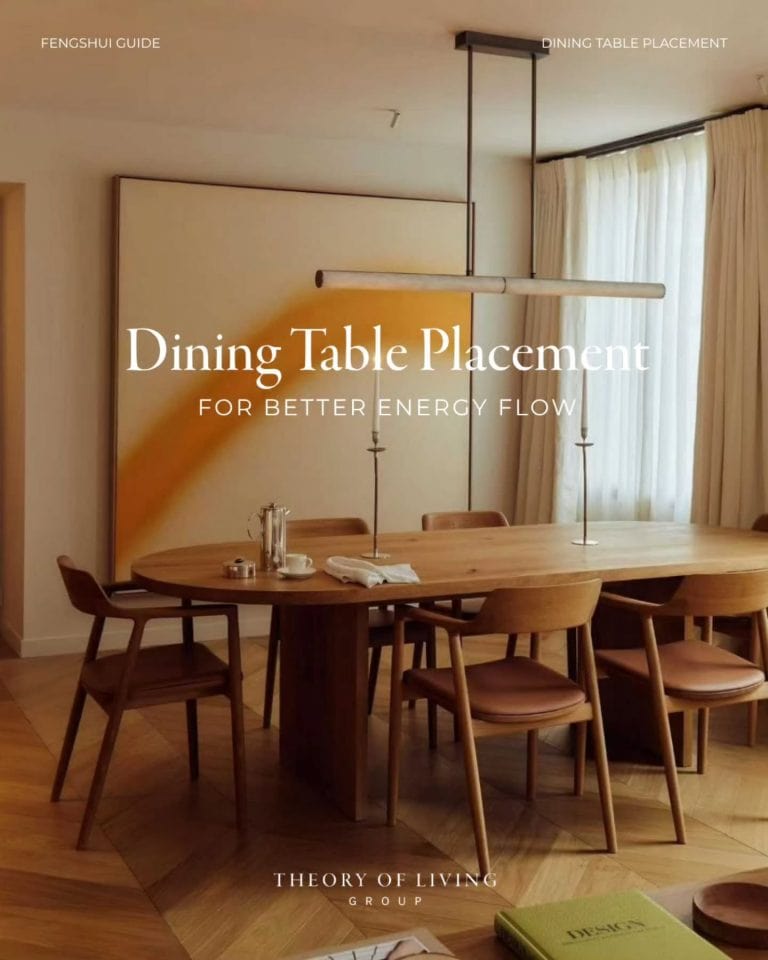
Where these features are unavoidable — a beam is structural, or the room only fits a rectangular table — the fix isn’t to renovate, it’s to soften. Round or oval tables sidestep the corner problem entirely, which is part of why they’re such a popular feng shui choice for dining. Where a beam can’t be hidden, warm, low-hanging lighting draws the eye downward and fills the space beneath it, softening the sense of weight from above.
4. Balance and Center the Table

A centered table brings a sense of stability and unity to a dining room — it reads as the room’s clear anchor, rather than something pushed to one side and slightly apologetic about being there. Where the architecture genuinely doesn’t allow for a perfectly centered table (an awkward column, an off-set window, a doorway that eats into one wall), the goal shifts from geometric centering to visual balance: a well-placed pendant light directly above the table, a rug that centers the seating area beneath it, or symmetrical decor on either side can all restore that sense of equilibrium even when the table itself sits slightly off-center in the room.
This is also where furniture proportions do real work. A table that’s noticeably too small or too large for its room will always look and feel unbalanced, regardless of exactly where it sits — so it’s worth measuring the room properly before choosing a table size, rather than the other way around.

Driftwood Chair
A grounded, well-proportioned piece that pairs naturally with a centered table.
Shop Now →
5. Choose Colours That Feel Nourishing

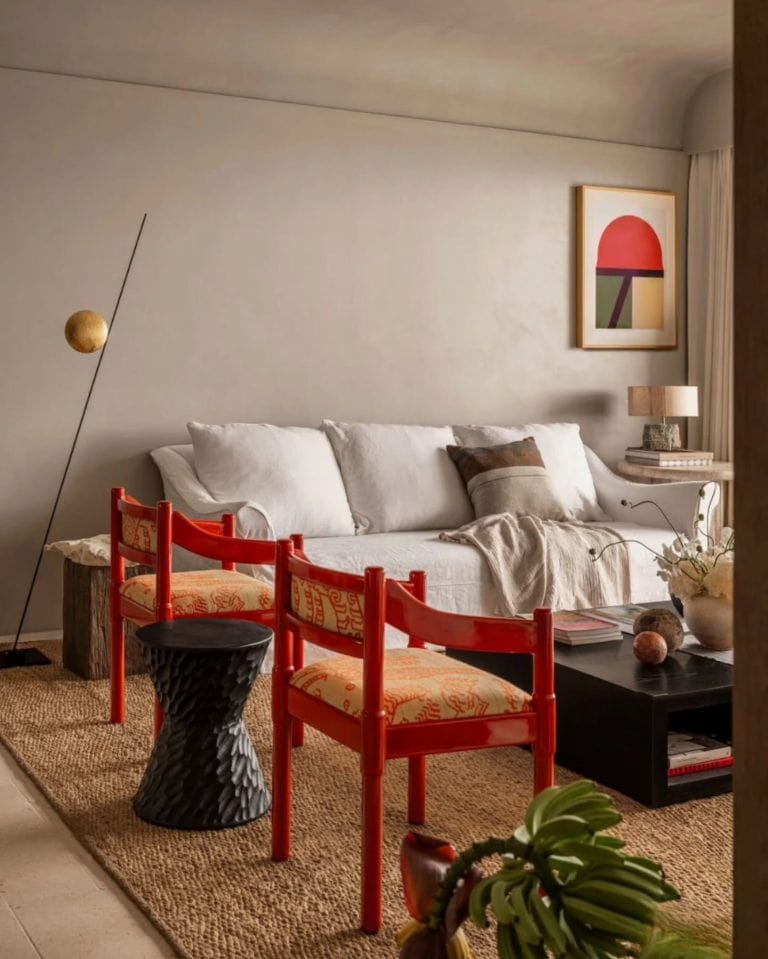
In feng shui, the dining room is associated with nourishment, abundance, and connection — and colour is one of the fastest ways to support or undercut that association. Warm, earthy tones create a grounded, welcoming atmosphere that puts people at ease before the first plate is even served.
Try: warm neutrals, soft terracotta, muted greens, and natural wood tones — either on the walls, in textiles, or simply through the furniture itself.
Avoid: letting the room feel cold or visually harsh with excessive stark white, very dark tones used without warmth to balance them, or overly intense, saturated colours that can overstimulate rather than nourish.
Natural materials do a lot of this work automatically. Solid wood, rattan, linen, and warm-toned upholstery all read as nourishing in a way that glossy, cold-toned surfaces simply don’t — which is part of why they show up so consistently in feng shui-considered dining rooms.

Amberline Chair
Warm, earthy upholstery designed to bring a nourishing, grounded feel to the dining table.
Shop Now →
Bringing the Principles Together
None of these five principles work in isolation — a perfectly centered table with the wrong colour palette will still feel off, and the warmest colour scheme won’t compensate for a table wedged directly in a doorway’s sightline. The goal is a dining room where placement, circulation, form, balance, and colour are all quietly working in the same direction, so the space feels effortlessly right rather than deliberately arranged.
Need help curating a dining space that feels balanced and beautifully considered? We’d love to help you find the right pieces for your space. Chat with our team on +62 812-6020-6008, or visit our showroom at Indonesia Design District, Jl. Rasuna Said 63, Pantai Indah Kapuk 2.