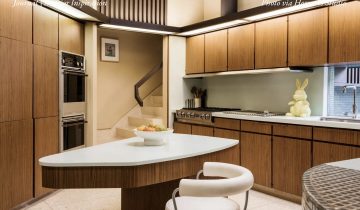
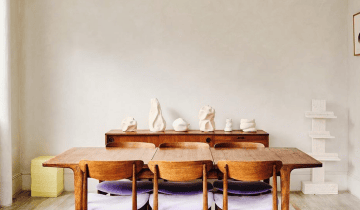
The dining room is the most social space in any home — and in 2026, designers are approaching it with a directness of purpose that it has not always received. The question is no longer simply how to make it beautiful but how to make it a place where people want to stay.
Proportion, light, and material — these are the three variables that determine whether a dining room holds people at the table or sends them to the sofa after twenty minutes. Each is worth understanding before making any purchases.
The Table: Scale and Shape
The dining table is the room’s anchor and its most consequential decision. Get it wrong and nothing else can compensate; get it right and the room organises itself around it.
Scale is the first question. The table should allow diners to sit comfortably with at least 60cm of table edge per person, and there should be a minimum of 90cm of clearance between the edge of the table and any wall or furniture to allow chairs to be pushed back and people to move freely. In a room that doubles as a circulation route, 100–105cm of clearance is more comfortable.
Shape is the second. Round and oval tables are superior for conversation — every diner has visual access to every other diner, and there is no head-of-table hierarchy. They suit square rooms and rooms where the table is used for everyday family meals rather than formal entertaining. Rectangular tables are better for longer rooms, for occasions where the table needs to extend, and for more formal arrangements where a clear orientation (head of table, guest of honour) is desirable. If you regularly seat more than eight, a rectangular extending table is usually the more practical choice.
In 2026, walnut and teak-toned tables with tapered legs are the dominant aesthetic — mid-century influenced, warm in tone, proportioned for modern rooms that typically have lower ceilings than the period they reference. A pedestal base is an elegant alternative for round tables, particularly if the room also needs to function as a passageway.
Chairs: Selection and the Mix
Chair selection is where dining room design most frequently goes wrong — usually through excessive caution. The matching-eight-chairs-from-a-set approach produces a room that is coordinated but lifeless. The mix-and-match approach, when executed well, produces rooms that feel collected, personal, and much more interesting.
The principle for mixing dining chairs successfully: maintain consistency in at least one element. That element can be seat height (so all chairs sit at the same level at the table), seat material (all upholstered in the same or complementary fabric), or finish (all chairs in the same wood tone, regardless of silhouette). Consistency in one dimension allows variation in the others without producing visual chaos.
A practical and elegant approach: use four to six matching chairs around the long sides of a rectangular table, and two distinctly different carver or end chairs at the heads. This creates a clear visual rhythm — the matching chairs provide the base, the end chairs provide the punctuation.
Upholstered dining chairs add warmth and extend the amount of time people comfortably spend at the table. Textured weaves in earthy tones — bouclé, heavy linen, nubby cotton — suit the warm neutral palettes that dominate dining rooms in 2026 and are significantly more forgiving than velvet for everyday use.
Lighting Over the Table
The pendant light above the dining table is the most important lighting decision in the room — and one of the most commonly mishandled. The two most common mistakes are hanging it too high and choosing a fitting that is too small for the table.
The rule of thumb: the bottom of the pendant should hang 75–85cm above the table surface. At this height, the fitting creates an intimate pool of light over the table without obstructing sightlines across it. Too high — the common default, usually out of a fear of the fitting feeling intrusive — and the light loses its relationship with the table and the diners, becoming a ceiling feature rather than a table feature.
The fitting should be roughly half to two-thirds the width of the table. A single large pendant over a rectangular table, or three smaller pendants in a row, both work well. Multiple pendants create more visual interest but require more careful spacing (typically at 60–80cm centres) to avoid looking accidental.
Bulb temperature matters as much as fitting selection: 2700K is warm and flattering for dining light; anything cooler reads as institutional. Dimmability is essential — a dining room that cannot be dimmed for evening entertaining has a fundamental limitation that no amount of styling will overcome.
The Sideboard
The sideboard or buffet is the dining room’s secondary piece — less essential than the table and chairs, but capable of transforming the room when it is right. Functionally, it provides storage for table linen, serving equipment, and overflow crockery. Aesthetically, it provides a surface for styling and a horizontal element that balances the table.
In 2026, the sideboard is treated as an object in its own right rather than purely as storage. Lower sideboards (around 75–85cm in height) suit contemporary rooms and allow the wall above them to function as a gallery or mirror surface. Higher sideboards read more traditional and provide better concealed storage.
The surface of the sideboard is a styling opportunity that rewards restraint. A lamp (or two), a pair of candle holders, one or two considered objects, a plant or a vessel with dried botanicals — and then nothing more. The sideboard surface that is fully loaded reads as a waiting area for objects without a home, not as a curated still life.
The Table as a Daily Ritual
The most persuasive argument for designing the dining room with genuine care is not aesthetic — it is behavioural. Rooms that are beautiful and comfortable to be in produce longer meals, better conversations, and more regular use than rooms that merely function.
The dining room designed to keep people at the table longer — through comfortable chairs, warm light at the right height, a surface that is pleasant to look at and touch — earns its investment not in a single occasion but in the accumulated hours of daily life around it.
Set the table, even when it is just a weeknight. The ritual of a set table signals that the meal matters, and the signal changes how the meal feels.
Curated Selection
Shop the Look
Set the table with pieces that pull the room together — from sculptural dining chairs to statement bar stools and layered rugs that anchor the space.

Akaylee Series AKQ-02
Price range: Rp 265,98 through Rp 396,18
Duneva Chair
Price range: Rp 737,18 through Rp 799,18
Calypsa Chair
Rp 985,18
Shoreline Chair
Rp 1.047,18
Jimmy Bar Stool
Rp 613,18Myer Bar Stool
Rp 613,18